

Franchising is booming across Europe. Despite economic uncertainties, the franchise model has shown remarkable resilience and growth from the UK to Central Europe. In France, franchised businesses generated €88.5 billion in sales in 2023 – a 15.6% jump from 2022[1]. Germany’s franchise sector hit €147.6 billion in turnover with over 147,000 franchisees in 2023[2]. The UK now boasts 1,009 franchise systems contributing £19.1 billion to the economy, with 89% of franchise units profitable[3]. Even in Spain and Italy, franchises are expanding steadily, creating hundreds of thousands of jobs[4][5]. Perhaps most striking: 99.5% of franchises succeed within their first 3 years, compared to a 50% failure rate for independent startups in the UK[6][7]. These numbers underscore franchising as one of the safest, fastest growth paths for businesses today.
So, is your business ready to ride this franchising wave? Transforming an SME into a franchise empire can unlock rapid expansion – but only if you’ve laid the groundwork. Franchising isn’t a magic wand; it’s a strategic journey requiring preparation, commitment, and savvy execution. In this comprehensive guide, we’ll walk you through a 7-point franchise readiness checklist, share data-driven insights and case studies, and compare franchising with other growth models. You’ll discover why franchising is a powerful expansion strategy in Europe’s diverse market – and how to avoid common pitfalls when scaling across borders.
Whether you’re an entrepreneur considering franchising your successful concept, a franchisor aiming for next-level growth, or an SME seeking strategic advice, read on. This article provides actionable frameworks, checklists (like “7 Signs Your Business Is Ready to Franchise” and “5 Growth Accelerators Every Franchisor Must Master”), plus European franchising trends and examples to inform your expansion plans. And if you need expert guidance, FMS Europe is here to help – from preparing companies for franchise growth to scaling established franchise networks, and comprehensive SME consulting in business strategy, marketing, digital and more. Let’s dive in.
Franchising on the Rise in Europe: Trends and Success Stories
Franchising is thriving across Europe’s major markets – even in the face of recent economic challenges. The model’s appeal is clear: it combines the strength of a proven business concept with the capital and drive of local owner-operators. Before we discuss how to franchise, let’s overview the European franchising landscape with some recent stats and success stories:
- United Kingdom: The UK franchise sector reached a record 1,009 franchise systems and 50,421 franchised units as of 2024[3]. Total economic contribution rose to £19.1 billion (up 12% since 2018)[8]. Notably, 89% of franchise outlets are profitable, and franchise ventures enjoy a far higher success rate than independent startups[8][7]. Growth sectors include personal services franchises, which jumped 53% in number of systems since 2018[9]. The British Franchise Association (BFA) survey underscores franchising as a “highly reliable route” to business ownership in the UK[6][7].
- France: France is often cited as Europe’s franchising leader in terms of networks and innovation. By end of 2023, France had 2,035 franchise networks running 92,132 franchised outlets – a 9% increase in outlets year-on-year[10]. These businesses created 951,600+ jobs (up 13% vs 2022) and generated €88.49 billion in sales (15.6% annual growth)[10][11]. France’s Fédération Française de la Franchise notes franchising has been growing for 50 years straight, now playing an “essential role” in the economy[12][10]. What’s driving this? Almost 43% of aspiring French entrepreneurs who want to start a business plan to do so by becoming franchisees – attracted by proven concepts and brand support[13]. This trend is fueled by career-changers (76% of new French franchisees were former employees) seeking autonomy with the safety of an established brand[14].
- Germany: Germany’s franchise sector is robust and still expanding. In 2023, there were around 910 active franchise systems in Germany, together operating 190,000+ businesses run by about 147,000 franchisees[2]. These franchise outlets employ over 830,000 people and achieved a total revenue of €147 billion in 2023[2]. (See Figure 1 for a snapshot of Germany’s franchise industry at a glance.) Germany’s focus has been on quality and partnership – the Deutscher Franchiseverband emphasizes that only well-tested, successful business models can be sustainably multiplied[15]. While France leads in number of brands, Germany’s higher unit count and revenues highlight its franchisees’ scalability. Major growth in Germany is seen in sectors like services, retail, and fitness. For example, Bodystreet, a German fitness franchise, grew from a single studio to over 300 studios across 7 countries by leveraging a unique workout concept and master franchising[16][17] – a testament to how a strong concept can rapidly scale via franchising.
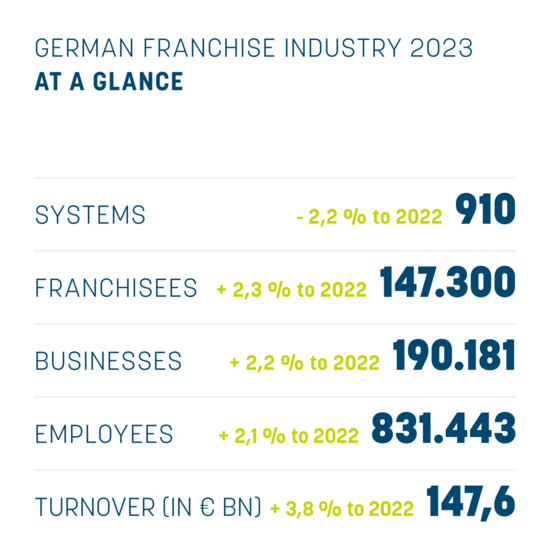
Figure 1: German Franchise Industry 2023 at a Glance – 910 franchise systems with 147k franchisees and €147.6B turnover[2]. Germany’s franchise sector shows steady growth in franchisees, businesses, and revenue, underscoring franchising’s economic impact.
- Spain: The Spanish franchise market has rebounded post-pandemic and continues to mature. By the end of 2023, Spain counted 1,384 franchise chains and 78,255 franchise locations nationwide[18][19]. Annual franchise sector turnover reached €27.6 billion (2.5% growth), about 1.9% of Spain’s GDP[20]. Crucially, franchises in Spain are major job creators – employing 318,300 people in 2023, up 4.8% from the previous year[4]. This is significant given Spain’s higher unemployment – franchising is providing opportunities and stability. The Spanish Franchise Association (AEF) also reports that 311 Spanish franchise brands have expanded to 140 countries[21], showing how homegrown franchises are using international franchising to grow. A case in point: Mr. Jeff, a Spanish tech-enabled laundry franchise founded in 2015, saw massive international success. It scaled to over 2,000 franchise locations across Europe, Latin America, the Middle East, and Asia within a few years[22][23], and even spun off multiple verticals (Beauty Jeff, Fit Jeff, etc.) via franchising. This illustrates the “franchising effect” – a local startup can become a global network rapidly by tapping entrepreneurial franchisees abroad.
- Italy: Franchising in Italy is on a steady growth trajectory as well. The latest Assofranchising Italia report shows 931 franchise brands operating in Italy in 2024, with 67,275 franchised stores (+2.2% vs 2023) and 293,791 employees (+2.1%)[24][5]. Total franchise turnover in 2024 hit €35.8 billion, about 1.8% of Italy’s GDP[25][26]. Notably, even after a slight dip in number of networks in prior years, Italy saw the trend reverse with new brands entering in 2024[27]. Top sectors by revenue are grocery retail ( €12.6B), fashion (€7.4B), and services (€6.7B)[28]. Italy’s franchise model has proved resilient through economic uncertainty, with a nearly 10% surge in turnover from 2022 to 2023[29]. Italian franchise experts highlight that for every €1 invested in franchising, it generates €2.8 in the wider economy – thanks to the multiplier effect of network growth[30]. In short, franchising is a “winning model” in Italy, enabling rapid scaling of retail and service concepts even amid global headwinds[25].
- Central & Eastern Europe: Beyond the big five economies, franchising is also gaining ground in Central and Eastern Europe (CEE). For instance, Poland now hosts hundreds of franchise brands (both local and international), with sectors like convenience retail exploding (e.g. Żabka convenience stores adding 1000+ franchised units in 2024)[31]. Countries like Spain, Belgium, Sweden, Romania have enacted franchise-specific laws (e.g. disclosure requirements) as franchising expands[32][33]. Franchisors are finding eager entrepreneurs in markets such as Poland, Hungary, and the Baltics, where franchising offers a ready-made business to those seeking opportunity. Many Western European brands are partnering with master franchisees in CEE to extend their footprint eastward. The result is an increasingly pan-European franchise ecosystem, where concepts cross borders more fluidly than ever.
The bottom line: Franchising in Europe is both big business and smart business. It’s delivering growth (in revenue and jobs) even in slow economies, by harnessing the power of local franchise owners. As John Spencer, former BFA chairman, noted: these survey results “give us vital, reliable data to benchmark the success and growth of the industry… franchising remains a safe place for those seeking to become self-employed”[34][7]. For SMEs, franchising can unlock expansion that far outpaces what traditional growth models achieve. But is franchising right for your business? Let’s examine how franchising compares to other expansion paths, and then dive into the 7-point checklist to evaluate your franchise readiness.
Franchising vs. Other Growth Models: Why Choose Franchising in Europe?
When plotting expansion, business owners have several models to consider: opening corporate-owned branches, licensing your product/brand, forming joint ventures or partnerships, or franchising. Each route has pros and cons. Franchising isn’t the only way – but it has distinct advantages, especially in Europe’s multi-country environment. Here’s a quick comparison:
- Corporate Expansion (Organic Growth): This is the DIY route – you open and operate new locations yourself, retaining full ownership and control. While it ensures consistency, it also means shouldering all the costs, risks, and management burden of each new unit. Expansion is limited by your capital and bandwidth. For many SMEs, rolling out dozens of company-owned stores across Europe is impractical due to the heavy investment and local knowledge needed in each market. It can take years or decades to achieve scale this way. Franchising, by contrast, leverages other entrepreneurs’ capital and local expertise – allowing much faster scaling with less capital outlay. For example, an SME that might afford to open 2 company stores a year could potentially add 10 franchises a year with the right partners.
- Licensing: Licensing is a lighter-weight model where you permit a third party to use certain intellectual property (IP) – such as your brand name, product formulas, software, or content – often for a fee or royalty, without the full business-format controls of franchising. It’s quick and relatively simple legally (fewer regulations and no need to provide ongoing support). However, you sacrifice control over how your brand or product is executed. As a Dentons franchising report quipped, “Licensing is like giving someone your workout plan and wishing them luck… faster and less regulated, but you lose visibility”[35]. There’s a risk of inconsistent customer experiences or brand dilution, since licensees aren’t required to follow a comprehensive system. Franchising is far more structured: “Franchising is the more comprehensive structure – granting partners the right to use your brand and adopt your business systems and customer experience via detailed manuals and training programs”[36]. In essence, a franchise is a replica of your business; a license is often just a bolt-on use of something you own. For a business model where customer experience and brand consistency matter (restaurants, retail, services, etc.), franchising usually outperforms licensing in the long run. A telling example: CrossFit grew explosively by licensing its fitness brand to independent gyms with minimal oversight – but this led to widely varying quality and safety standards, undermining the brand’s reputation[37][38]. In contrast, competitors like F45 Training franchised with strict workout systems and achieved rapid scaling plus a successful IPO, precisely because they maintained consistency[39][40].
- Partnerships & Joint Ventures: Some companies expand internationally via joint ventures, strategic alliances, or master franchise-like partnerships (e.g. finding a local partner to co-own and operate the business in a new country). This can work well for specific large ventures or when local market knowledge is critical. However, JVs often involve complex agreements and shared decision-making, and they still require significant capital investment by the parent company in many cases. Franchising, especially master franchising or area development franchising, is often a more clear-cut way to partner in new markets: the local party (franchisee) invests and runs the operations, while you provide the know-how and brand, for fees. The relationship is defined by the franchise contract rather than an equity share. In Europe, where entering each country can be like entering a new market with unique consumer habits and regulations, franchising with local owner-operators offers a powerful balance: you get “on-the-ground expertise” without giving up ownership of your brand or having to navigate foreign markets alone[41][42]. The local franchisee’s cultural and regulatory knowledge is invaluable – “a strong local operator can navigate local market nuances and establish credibility with consumers far faster than you could alone,” notes franchise veteran Bob Kaufman[41][42].
- Speed and Scale: Ultimately, franchising enables a scale of expansion that other models find hard to match. By tapping franchisees’ capital, even a small business can open many locations in parallel. Because franchisees are highly motivated owners, the brand can grow quickly without the central company micromanaging every unit’s daily operations. This has been demonstrated by countless brands – e.g., McDonald’s famously expanded across Europe through franchising, leveraging entrepreneurs in each country to localize and grow the outlets. For European SMEs, franchising can mean going from a regional player to a national or international chain in a few years, something that could take decades with company-owned growth.
- Control and Brand Protection: Franchising does require giving up a degree of direct control – you won’t run each outlet day-to-day. But well-structured franchising actually protects brand consistency through its legal and operational framework. Franchisees contractually agree to follow your operating manual, training, and standards, something you cannot enforce with a mere license or loose partnership[36][37]. European markets place high importance on brand reputation; franchising ensures each location upholds your brand’s promise, because the franchisor can terminate or not renew franchises that don’t comply. Moreover, European franchise associations and many national laws emphasize pre-contract disclosure and ethical franchising, giving franchisees clarity and building long-term trust. For example, countries like France, Spain, Belgium, and Sweden legally require franchisors to provide a Disclosure Document to prospective franchisees days or weeks before signing, detailing the franchise offer[32][33]. This transparency ultimately leads to stronger partnerships and a healthier network compared to informal expansion arrangements.
Why Franchising is Powerful in Europe:
Europe is not a monolith – it’s a mosaic of markets, languages, and cultures. Franchising uniquely marries centralized brand control with decentralized local adaptation. A good franchise system provides a proven core model (brand, product/service, systems) that is consistent, while empowering local franchisees to tailor and execute effectively in their country or region. For instance, a franchise can adapt its menu or marketing slightly in Italy vs. Sweden while keeping the brand essence the same – guided by the franchisor’s 70/30 rule (70% standard, 30% localized)[43]. This is often more effective than a corporate expansion trying to manage everything from headquarters, or a loose licensee doing their own thing with no oversight. As Bob Kaufman advises, “international franchising isn’t about forcing a concept on a new market, it’s about translating its best elements in a way that resonates locally”[44][45]. Franchising gives you that translation mechanism via committed local partners.
Lastly, franchising aligns incentives: franchisees are invested in the success of the brand – they’ve put their own money and sweat into it – so they work hard to grow the business in their market. Contrast this with a hired manager of a company-owned branch or a casual licensee; the franchisee’s level of commitment is usually higher. For a continent as diverse as Europe, having passionate local owners can make the difference between a concept thriving or failing abroad.
In summary, franchising often offers faster growth, broader reach, and sustained brand integrity compared to other models, especially when you need to navigate multiple countries. It’s asset-light and leverages entrepreneurial energy from others. Of course, it’s not without challenges – you must select the right franchisees and maintain support (more on that later). But when done right, franchising can be your strongest growth engine. With that in mind, let’s turn inward: is your business positioned to capitalize on franchising? Time for the 7-point checklist.
7 Signs Your Business Is Ready to Franchise
Not every successful business will make a successful franchise. Before you start selling franchises, ensure you meet these 7 key criteria of franchise-ready businesses. Use this checklist as a frank diagnostic: if you can check off most of these signs (or are willing to take action to get there), you’re likely ready to franchise. If not, you may need to shore up certain areas – and remember, FMS Europe can assist in preparing you to meet these benchmarks:
1. You Have a Proven, Profitable Business Model.
Franchising replicates success, so you need a track record of success to replicate. Ideally, your business has been operating for at least a couple of years with consistent profitability and demand. You’ve weathered the startup phase and demonstrated that the concept works in practice[46]. This means solid financials: an established revenue stream, repeat customers, and profits that aren’t razor-thin. A franchisee will want evidence that if they copy your model, they too can make money. As franchise advisors note, having a proven, successful business model with a well-established customer base is the first sign you’re ready to franchise[47][48]. For example, if you run a restaurant that’s consistently full and profitable at one location, or a retail store that’s thriving in multiple outlets you own, that’s a good indicator. Red flag: If your business is still struggling to find product-market fit or barely breaking even, fix that first – franchising magnifies success, but it can also magnify problems if the model itself isn’t profitable.
2. Your Brand is Distinctive and Scalable.
A strong brand is fundamental for franchising – it’s what attracts franchise buyers and customers alike. Is your brand identity well-defined, professional, and appealing for a wider market? A good test: Would your brand work in another city or country, not just your hometown? If your business name or concept is too tied to a local area or a person (e.g., “John’s London Catering”), consider rebranding to something more universal[49]. Successful franchise brands usually have a clear USP (Unique Selling Proposition) or differentiation that sets them apart from generic competitors[50]. It doesn’t have to be one-of-a-kind, but it must offer a clear point of difference and a value that is sustainable long-term[50]. Ask yourself: is the demand for your product/service likely to last, or is it a fad? Franchisees and their bankers will ask the same. Case in point: A frozen yogurt shop might have been trendy for a while, but if the craze fades, franchises will struggle. On the other hand, a brand built around a lasting consumer need (healthier fast food, affordable childcare services, eco-friendly products, etc.) with strong branding will have staying power[51]. Ensure your trademarks are protected and your brand image can be replicated in signage, online, packaging, etc. If you can confidently say “yes, my brand could be rolled out nationally/european-wide and would attract customers,” you’re on the right track.
3. Your Business is Replicable – Systems and Processes are Documented.
Franchising means teaching someone else to run your business exactly as you do (and hopefully even better). For that, your operations must be standardized, documented, and teachable. You should have clear operating procedures for all aspects – e.g. how to prepare the products or deliver the service, customer service protocols, supply chain, point-of-sale system, marketing tactics, etc. A future franchisee with reasonable training should be able to learn your system and operate independently. If your success relies on skills or knowledge unique to you (the founder) or a few key staff, you need to extract that know-how into manuals and training programs[52][53]. As one franchising expert put it: “If your business relies on specialized skills or knowledge only you possess, you may need to simplify and document your processes before franchising”[54]. Technology can help here – many modern franchisors use software to systematize everything from inventory management to employee training. A quick self-check: Could you step away from your business for a month and have it still run smoothly on the systems in place? If yes, it’s likely system-driven rather than founder-dependent – a good sign for franchising. If no, start documenting and standardizing now. Franchisees want a “business in a box” they can plug and play, not a puzzle to figure out from scratch.
4. Unit Economics are Strong (Win-Win Profit Margins).
A franchise must be financially worthwhile for both the franchisee and you (the franchisor). That means each franchise unit should be able to generate enough profit to support two layers of income – one for the franchisee (after they pay royalties), and one for the franchisor (via those royalties and fees). High gross margins or sufficient net margins are crucial[55][56]. If your current business operates on very thin margins, adding franchise royalties on top could make it unviable for a franchisee. Typically, franchises work best in businesses with healthy margins or volume such that a franchisee can pay, say, a 5-10% royalty and still make a good living. The franchisor’s cut, in turn, must cover the costs of supporting the network and leave profit. A general rule: ensure a franchisee can recoup their initial investment within a reasonable time (e.g. 2-4 years) and then enjoy profitability; otherwise, franchise sales and sustainability will suffer. In the UK, franchise experts note franchising is “not suited to low-margin businesses” – there needs to be enough profit for both parties to succeed together[55][56]. Consider running some financial models: if a franchisee opened your business and paid the expected fees, what would their ROI look like? If the numbers don’t excite, you may need to adjust the model (e.g., lower build-out costs, negotiate bulk supply discounts to improve margins, or adjust fee structure). Remember, a franchise relationship must be win-win – “both franchisee and franchisor succeed together” in a sustainable way[56]. If it’s lopsided (all profit to you or all to them), it won’t last.
5. You’re Committed to Supporting Franchisees (Leadership & Culture Fit).
This is a more intangible but vital sign. Shifting from running your own business to becoming a franchisor means becoming a coach, leader, and partner to your franchisees. It requires a mindset of helping others succeed, not just doing it all yourself. Ask: Are you (and your management team) prepared to provide ongoing training, field support, and guidance to franchisees – who are not your employees but independent owners? As one consultant advises, “Franchisees must be treated as equals – you lead with authority but you can’t dictate”[57][58]. Good franchisors actively listen to franchisee ideas and concerns, fostering a culture of collaboration. You must be ready to “let go of the reins” on day-to-day operations and empower franchisees to drive the business forward in their market[59]. If you enjoy mentoring and can be patient and supportive (yet assertive about enforcing standards), franchising will suit you. If you’re extremely control-oriented or unwilling to adapt your style, franchising could become frustrating. Moreover, supporting franchisees is a long-term commitment – you’re signing 5, 10, maybe 20-year agreements. Ensure you have the passion and bandwidth to fulfill that commitment. When franchisees invest their life savings in your brand, they expect you to be in their corner, especially in the early years as they ramp up. Franchising is as much about people as it is about systems. If you’re enthusiastic about building a community of entrepreneurs and celebrating their success as your own, that’s a green light. As FMS Europe’s experience shows, the most successful franchisors genuinely care about their franchisees’ growth and invest in it – through coaching, conferences, innovation, and more. Are you ready to become that kind of business mentor?
6. Sufficient Resources and Team to Scale.
Before franchising, take stock of your organizational capacity. Running a franchise network – even a small one – requires resources that a single-unit business might not have. You’ll need to handle franchise marketing and recruitment, legal compliance, training new franchisees, and ongoing support (site visits, troubleshooting, etc.). Do you have key staff (or plans to hire) who can take on these functions? For example, many franchisors appoint a Franchise Development Manager (to recruit quality franchisees) and a Franchise Support Manager (to coach existing franchisees). You’ll also need to prepare training programs, operations manuals, and perhaps new marketing collateral for franchise expansion. All this takes time and money. Ensure you have capital set aside to develop the franchise infrastructure – drafting legal documents, maybe registering trademarks in new markets, setting up a franchisee intranet or software, etc. A common mistake is underestimating the upfront investment to launch a franchise program. Make sure your core business is healthy enough to fund this, or you have access to financing. Additionally, consider whether you might need to outsource certain tasks initially (franchise consultants, lawyers, etc.) – that’s fine, as long as you budget for it. The goal is to be able to support a network of franchisees on a daily basis, not just get them signed up[60][61]. If currently you’re stretched thin just running one unit, think about who will handle franchise queries at 8pm from a franchisee, or who will fly to Germany to help open a new store, while you maintain your original location’s success. Having (or planning for) the right team in place is crucial[61]. The good news is you don’t need a massive headquarters like McDonald’s to start franchising; many emerging franchisors are small teams that leverage external advisors. But you do need a realistic support structure from day one. In short: don’t franchise until you can uphold your end of the bargain – providing the training, support, and leadership your franchisees pay for.
7. Strong Market Demand Beyond Your Current Location.
Lastly, a great sign of franchise potential is when people outside your area are clamoring for your product/service – or even asking if you offer franchises. Perhaps you’re getting inquiries from other cities or countries on social media (“When are you coming to Dublin?”). Or you’ve maxed out the local market and still have unmet demand (long customer waitlists, etc.). If you find you’re “turning away business” or unable to serve certain incoming opportunities due to geographic limitations, franchising could be the answer[62]. Conduct some research: Are there similar markets (in demographics or trends) where your concept could thrive? The presence of copycats or competitors in other regions can also indicate a market opportunity. Assess the scalability: For instance, if you have a boutique fitness studio that’s a hit in your city, is the fitness trend it rides also popular elsewhere in Europe? If yes, franchises could tap that wider trend. The Franchiser UK suggests that noticing “interest or demand for your product in other regions” is a key indicator it’s time to consider franchising[63][64]. You should also study potential territories for any major hurdles (e.g., different regulatory requirements, vastly different consumer preferences) – nothing insurmountable, but it’s wise to know if adaptation is needed. Overall, if the only thing stopping you from expanding to meet demand is lack of capital or bandwidth, franchising can bring those resources via franchisees. One caution: ensure that growth into new markets won’t cannibalize your existing business (e.g., if territory overlaps might occur, set clear franchise territories). But in general, strong external demand is a promising green light. Some franchise founders even start franchising because loyal customers from other cities beg them for a franchise – a high-quality problem indeed!
If your business ticks most of these boxes, congratulations – you may be ready to franchise!
Many companies find they meet some criteria but not all; that’s okay. Any gaps identified here are areas to work on before launching your franchise program. For example, you might need to spend 6 months documenting processes and beefing up margins, or hire a franchise operations manager. It’s worth the prep: a half-baked franchise rollout can damage your brand and finances, whereas a well-prepared one can be transformative. As the Business Franchise survey put it, don’t be afraid to “ask for help in getting your business franchise-ready”[65]. This is exactly where FMS Europe supports clients – conducting franchise feasibility studies, developing operations manuals, crafting financial models, and guiding businesses through the franchise setup process. Proper preparation could be the best decision you make to ensure your franchise expansion is a success from day one[65].
Now that you know what it takes to be franchise-able, let’s assume you’re moving forward. What next? In the franchising journey, signing up your first few franchisees is just the start. To truly scale to the next level – whether that’s 10 units or 100 or international expansion – you’ll need to excel at franchisor management. The next section covers 5 growth accelerators every franchisor must master to grow a thriving, sustainable franchise network.
5 Growth Accelerators Every Franchisor Must Master
Launching a franchise is a major milestone – but scaling it is a whole new challenge. Many young franchisors sign a handful of franchisees quickly, only to stall out or run into issues that impede further growth. To avoid the “growing pains” and accelerate your franchise system’s expansion, focus on mastering these five critical areas. These are the growth accelerators that top franchisors (and their savvy advisors, including FMS Europe) emphasize:
Accelerator 1:
Fanatical Focus on Franchisee Profitability and Unit Performance. The health of your franchise network directly depends on the financial success of your franchisees. If franchisees aren’t making good returns, your franchise growth will halt – period. No one will buy new franchises and existing ones may close. Thus, a growth-oriented franchisor constantly works to improve unit-level economics. This could mean negotiating better supplier pricing, introducing operational efficiencies, or sharing best practices that drive sales. Private equity investors (who often buy into successful franchises) cite “a steadfast commitment to improving profitability at the unit level” as key to driving franchise expansion[66][67]. In fact, a franchisor’s mantra should be: if franchisees can’t make good returns, the business can’t grow[67]. For example, one strategy is implementing performance dashboards or KPIs for each franchise unit – measuring things like sales per customer, labor cost %, inventory turnover, etc., and coaching franchisees on hitting targets. Franchise systems that do this see tangible results. As evidence, consider a case study from a boutique fitness franchisor: they introduced performance coaches, each overseeing 10 franchise units with regular check-ins and playbooks. The result was a 22% increase in unit profitability and higher franchisee satisfaction in 18 months[68]. That kind of profit boost not only keeps current franchisees happy (and renewing and expanding), but also becomes a selling point to attract new franchisees. In Europe, where costs and economic conditions vary by country, helping franchisees maximize profit in their local context is especially important. Localization of strategies (within the system framework) can help – e.g., a franchisor might adjust pricing models or menus slightly in a country where consumer behavior differs, to ensure franchisee margins remain healthy. Bottom line: Your growth is a direct reflection of their growth. Treat franchisee profitability as the sacred metric and you’ll create a virtuous cycle of expansion.
Accelerator 2: World-Class Training and Onboarding Programs.
How you train new franchise owners from day one can make or break their success – and thus your network’s success. Structured, effective onboarding reduces rookie mistakes, speeds up openings, and builds confidence. An IFA (International Franchise Association) report found that “structured onboarding reduces first-year franchise failure rates by 40% and improves time-to-profitability by 30%”[69]. Those are huge differences that directly impact growth (early failures or slow ramp-up can tarnish your brand and scare off prospects). Invest in a comprehensive training program that covers not only operations but also business management: teach franchisees how to hire, how to market locally, how to manage finances – remember many may be first-time business owners. Use multiple formats: classroom training, hands-on in your flagship location, online modules, and perhaps a mentorship system (pairing new franchisees with experienced ones). The goal is to turn a franchisee into a confident operator by the time they open. And training shouldn’t stop at launch – ongoing training (refresher courses, new product rollouts, etc.) keeps the network sharp. Especially when expanding across Europe, adapt training for cultural and language differences as needed. For instance, if your franchise manual is in English but you’re signing franchisees in Poland and Italy, consider translating key materials or providing bilingual support staff. Investing in great training is investing in faster growth – because successful franchisees will lead to positive validation (see Accelerator 5) and more openings. As one expert succinctly put it: “Because a 300-page manual isn’t a mentor… a checklist doesn’t instill confidence”[70] – it’s the human, interactive training that truly prepares franchisees to shine.
Accelerator 3: Strong Ongoing Support and Communication (Franchisee Engagement).
Many franchisors make the mistake of focusing heavily on franchise sales but underestimating the importance of supporting franchisees after they sign. In reality, franchisee support is not a cost center; it’s a growth engine[71]. When your existing franchisees are well-supported and engaged, they perform better and are more likely to expand (through multi-unit ownership or simply higher same-store sales) – fueling growth from within. They also become your best brand ambassadors for selling new franchises (nothing sells better than a happy franchisee referral). What does strong support look like? It includes regular coaching calls or visits, a responsive help desk for operational issues, ongoing marketing support, updated training, and a sense of community. For example, many successful franchisors implement field support staff who consult franchisees on their business metrics and help troubleshoot. The earlier case of performance coaches in a fitness franchise highlights how formalizing support can boost profits[68]. Engagement is equally critical. According to Franchise Business Review data, brands with high franchisee engagement have 2.4x higher per-unit revenue than those with disengaged franchisees[72]. Engagement means franchisees feel heard and valued – perhaps through a franchise advisory council, regular surveys, and transparency from leadership on decisions. European franchise networks sometimes span dozens of nationalities – proactive communication ensures everyone stays aligned despite distance. Consider annual franchisee conventions or regional meet-ups in Europe to share best practices and build camaraderie. As one franchisor said, “if your franchisees don’t feel supported, heard, and equipped, they won’t thrive. And neither will you.”[73][74]. Make support and engagement part of your brand DNA. Not incidentally, franchisee satisfaction and success feed directly into growth: satisfied franchisees are more likely to open additional units and less likely to leave, increasing your system size organically. Conversely, poor support will lead to stagnation or contraction. The cost of a support team or program is repaid many times over by stronger performance across the network.
Accelerator 4: Effective Marketing and Brand Development (Local + National).
To scale up your franchise, you need to scale up brand awareness and customer acquisition – both at the national (or international) level and the local level. Franchisors that master marketing will outpace others in growth because their franchisees hit the ground running with demand generation. Key components include: a strong digital presence (modern website, active social media, SEO for franchise locations), compelling campaigns that can be adapted locally, and perhaps national advertising funds for broad reach. Each new market you enter in Europe might not know your brand at all – having a playbook to quickly build brand presence in a new city or country accelerates how fast a franchisee reaches break-even. This might involve PR buzz, launch events, and strategic use of digital ads targeted to that locale. Additionally, help franchisees with local marketing toolkits – materials for community outreach, guidance on using Google Ads or local Facebook marketing, etc. Franchisors that invest in data-driven marketing see results: for example, home services franchisor Neighborly (with brands like Mr. Handyman) provides sophisticated marketing support to franchisees, resulting in higher lead flow system-wide and more franchises sold (PE investors loved this and scaled Neighborly to 30+ brands)[75][76]. In Europe, marketing must often be multilingual and culturally tailored – ensure your branding can flex where needed (e.g., translation of slogans, avoiding images or messages that don’t resonate in certain cultures). But the core should remain consistent so that the brand builds a pan-European identity over time. Another aspect is leveraging new marketing channels and tech: successful franchisors often adopt apps, loyalty programs, or partnerships that individual franchisees could not develop alone, giving the whole network an edge. For instance, a restaurant franchisor might launch an online ordering platform for all franchisees, boosting sales network-wide – a growth driver. And don’t forget B2B marketing if applicable (some franchises grow by signing corporate clients or contracts that benefit all units). In summary, view marketing as a central pillar of your franchise growth strategy. If this isn’t your personal strength, hire or consult experts (FMS Europe’s marketing and digital consultancy comes in handy here) to create a robust marketing engine that fuels franchisee success across diverse European markets.
Accelerator 5: Culture of Innovation and Continuous Improvement.
The marketplace doesn’t stand still – and neither should your franchise system. Franchisors that achieve long-term growth demonstrate a commitment to evolving and improving the business model continually. This doesn’t mean changing your core identity, but rather, keeping the concept fresh and competitive. Introduce new products or services as consumer trends shift, upgrade technology, and refine operations by learning from experience. A great practice is to involve franchisees in innovation: they often have front-line insights. Set up channels for franchisee feedback and pilot programs. Some European franchise networks establish innovation committees or encourage franchisee-led initiatives that, if successful, roll out to all. For example, a franchisee in France might experiment with a new service offering; if it increases revenue, the franchisor can adopt it system-wide. Embracing technology is a big part of innovation now – many franchisors are adopting software solutions for everything from online training to supply chain to customer analytics. The Fieldfisher franchise law blog observed that many franchise systems are incorporating new tech solutions, developing software in-house or via third parties to enhance their business – but cautions this adds complexity that franchisors must manage carefully[77][78]. The payoff, however, can be significant efficiency and new revenue streams (e.g., licensing software to franchisees). The best franchisors regularly ask: “How can we help our franchisees make more money or operate easier?” and then take action on the answers. This mindset is an accelerator because it keeps the system attractive for new buyers and helps existing franchisees grow their sales (leading them to invest in more units). A study by FranGrowth found that brands achieving sustained growth have a deep understanding of their KPIs and relentlessly refine processes to improve system efficiency and franchisee profitability[79][80] – and those that “rest on their laurels” eventually stall[81]. In Europe, staying ahead might mean adapting to new regulations (e.g., environmental rules, data protection laws) faster than competitors, or localizing offerings (maybe a franchise adds vegan options in countries with rising demand, etc.). The ability to innovate within the franchise framework is a hallmark of franchises that go from 10 units to 100 and beyond. It also future-proofs your brand against disruption. Encourage a culture where everyone in the system, franchisor team and franchisees, are thinking of ways to improve. As the saying goes, “successful franchise brands are committed to constantly improving their systems, while staying true to what made them great”[81].
By focusing on these five areas – franchisee profitability, excellent training, strong support, savvy marketing, and innovation – you create a solid foundation for accelerated growth and scalability. It’s no coincidence that these align with what private equity looks for in valuable franchise businesses (strong unit economics, good support, brand differentiation, growth potential)[82][83]. Even if you’re not looking for investment, running your franchise as if you were is a good discipline for growth.
Let’s address one more crucial topic: expanding your franchise across Europe means navigating some unique cross-border challenges. Understanding these and planning for them will further ensure your expansion is smooth and successful.
Navigating European Expansion Challenges: Legal, Cultural, and Consistency Hurdles
Expanding a franchise within one country is complex enough; expanding across Europe’s patchwork of jurisdictions and cultures adds extra layers of challenge. But knowledge is power. Here are key European-specific challenges franchisors face – and tips to overcome them:
Multi-Country Legal Frameworks:
Unlike the U.S., Europe doesn’t have one unified franchise law – each country has its own regulations (or sometimes, none specific to franchising). For example, France requires a detailed “Document d’Information Précontractuelle” (DIP) disclosure to be given to a franchise prospect at least 20 days before contract signing[32][84]. Spain has franchise disclosure and registration rules as well. Germany and the UK rely more on general contract law and industry self-regulation (codes of ethics). Some countries (Italy, Poland, etc.) require certain terms to be included in agreements, or have specific trademark registration needs for franchising. The EU level has competition law (the Vertical Block Exemption Regulation) that affects certain franchise practices (like exclusivity or pricing policies) across all member states. Solution: It’s essential to work with franchise-experienced legal counsel for each target country or region. Often, franchisors create a base franchise agreement and then localize it per country with riders or country-specific addenda. Be prepared to comply with each country’s pre-sale disclosure requirements – failing to do so can lead to nullified contracts or penalties. Organizations like the European Franchise Federation and local franchise associations are valuable resources to understand local best practices. Also, consider starting with a Master Franchise or Area Developer for a new country – they often handle local legal compliance, easing your burden. In short, do your homework and get expert advice. The administrative overhead is real, but many have trodden this path before. A well-managed legal strategy will protect your brand and avoid costly disputes. Franchising across borders is very doable (hundreds of franchises do it successfully) – just don’t copy-paste your domestic contract without vetting it under, say, French law. As one global franchising advisor noted, “laws and regulations in each European country are very different, and it’s important for franchisors to obtain legal counsel in each”[85][86]. Build these compliance steps into your expansion plan timeline.
Cultural Adaptation and Local Consumer Preferences:
Europe’s cultures can differ widely – what sells in Sweden might flop in Italy if not adapted. One of the biggest mistakes in international expansion is assuming what works at home will work everywhere[87][88]. Successful European franchisors balance brand consistency with cultural sensitivity. For instance, menu franchises adapt flavors to local tastes (a spicy level acceptable in one country might be too high in another; a “Pumpkin Spice Latte” that’s a hit in the US was meaningless in Asia – they swapped in local favorite flavors[89][45]). In Europe, consider language – ensure your branding and slogans make sense and have no negative connotations in the local language. Adapt marketing imagery to local norms. Even business etiquette with franchisees can differ (some cultures prefer very direct communication, others expect more formalities). Solution: Leverage your local franchisees’ input – they are native to their markets. During your franchisee selection, target partners who not only have business skills but also understand the local customer deeply and can advise on tweaks. Remember Bob Kaufman’s 70/30 rule for global franchising: keep ~70% of the brand & systems consistent, adapt ~30% to fit local customs and market conditions[43]. Before launching in a new country, do market research: study competitors, consumer behavior, price sensitivities[90][91]. Maybe run a pilot or pop-up to test the waters. Don’t be afraid to adjust the model where it makes sense – as long as you protect the core brand values. Many franchises create a “European version” of certain products or a slightly different service bundle to meet regional demand. Also, consider cultural differences in franchisee expectations: for example, franchisees in some countries might expect more marketing spend from the franchisor, or different types of support. Adapt your approach accordingly (without breaking your economics).
Cross-Border Brand Consistency and Quality Control:
Maintaining a consistent customer experience across many countries is challenging. Distance makes supervision harder, and there’s a temptation to let standards slide “because that market is different.” But inconsistency can hurt the brand overall – especially in the age of travel and the internet (customers notice if a franchise location abroad is subpar and it reflects on the brand globally). Solution: Double down on your training and audit processes for international units. Schedule regular visits or send teams to international franchises for quality assurance. Some franchisors establish regional support offices or hire area managers in Europe to be closer to the action. Use technology: for example, require each location to submit key metrics and perhaps photo reports via an intranet, or use mystery shoppers across markets. Implementing a Franchise Operations Manual that is clear on non-negotiables vs. optional variations is key[89][92]. The Dentons insight earlier noted that franchising requires “detailed manuals, training, audits, and brand-standard enforcement” akin to a personal trainer monitoring technique, whereas licensing is like giving a plan and walking away[35]. So, lean into the franchisor role of enforcing brand standards – even if it means tough conversations with a master franchisee who wants to cut corners. Protecting brand consistency across borders often also involves protecting intellectual property – ensure your trademarks are registered in each country you operate in (EU trademark may cover many, but check if you need UK-specific after Brexit, etc.). Also, be mindful of translations of your brand – consistency in logo and messaging should be upheld, with localized language as appropriate. In franchising, you want the customer to forget that outlets are separately owned – they should feel “It’s the same great brand I trust, wherever I go.” Achieving that in Europe’s varied landscape is not easy, but robust training, frequent communication, and a culture of pride in the brand can get you there.
Logistics and Supply Chain Differences:
If your franchise involves physical products, consider how you’ll supply franchises in different countries. Will you ship from a central warehouse, or source locally? Import/export rules, tariffs (if outside EU or post-Brexit UK), and lead times can impact unit economics. Many franchisors find local suppliers for perishable or bulky items and only export proprietary items that are unique to the brand. You may need to form partnerships with European manufacturers or distributors. Factor in currency differences and economic fluctuations – a franchisee’s costs and pricing might need adjustment if currency swings occur (e.g., Euro vs Pound). Solution: Plan your supply chain early for each new region. Master franchisees can help localize sourcing. Ensure quality control if sourcing locally – approve suppliers that meet your specs. If holding inventory centrally, you might set up a EU distribution center for efficiency if volume grows. The more you can streamline supply chain for franchisees, the more competitive they can be in their market.
Different Consumer Protection and Labor Laws:
Europe has strong consumer protection laws and these can affect franchise operations (for example, generous return policies mandated in EU, or allergen labeling requirements in restaurants). Labor laws too – work hours, benefits, etc. – vary and may affect a franchise’s cost structure. While franchisees manage their own compliance, as franchisor you should be aware of these factors as they can influence the business model per country. For instance, a country with very high labor costs might need a slightly different model (more self-service, or smaller footprint) to be viable. Solution: Adapt the franchise format if needed per country. Some fast-food franchises in Europe offer limited menus or different service styles to cope with high wages or regulatory context, yet they keep the brand intact. Again, your local partners will be your guide.
In summary, European expansion requires flexibility, research, and local partnership. It’s about finding the sweet spot between global brand consistency and local market relevance. The challenges are real, but none are insurmountable – countless franchises have expanded in Europe successfully by respecting these aspects. As franchisor, approaching Europe with a mix of confidence and humility – confident in your brand, humble enough to listen and adapt – will serve you well. FMS Europe often coaches clients through these cross-border nuances, ensuring that their expansion strategy is compliant, culturally astute, and operationally sound. With the right preparation, your franchise can achieve truly continental reach and recognition.
Conclusion: Accelerate Your Growth – And Get the Right Partners on Your Side
Franchising can be a game-changer for businesses poised to expand. We’ve seen how the franchise model is fueling growth across Europe, from the nearly million jobs created by franchises in France[10] to the 99.5% success rate of franchise units in the UK[6][7]. We’ve walked through a 7-point readiness checklist – covering everything from proven financials to replicable systems to the mindset shift required – so you can candidly assess if franchising is the right next step for your company. And we’ve explored how to drive franchise growth post-launch, emphasizing franchisee success, robust training, continual support, effective marketing, and innovation as the pillars that hold up a thriving franchise network.
Expanding via franchising is not an overnight endeavor. It’s a strategic journey that demands preparation, patience, and a willingness to learn and adapt. It challenges you to move from being an operator to being a leader of operators. But for those businesses that are ready – or determined to get ready – franchising offers unparalleled advantages: rapid expansion with reduced capital strain, local owner-driven management, and a scalable way to multiply your business success far beyond what you could achieve alone.
So ask yourself: “Is my business ready to franchise?” If you’ve checked off many of the readiness signs and you’re excited by the prospect of seeing your brand in dozens of cities (or multiple countries), then now may be the time to take action. If a few boxes remain unchecked, that’s fine – now you know where to focus. Perhaps you need to shore up your operations manual or improve profitability by 5% or register your trademark in key markets. These are all feasible tasks that will strengthen your foundation.
And remember, you don’t have to navigate this process alone. Franchising, especially in the European context, involves many moving parts – strategic, legal, operational, and cultural. Engaging experienced advisors can significantly smooth the road. FMS Europe has guided companies across industries to franchise success, helping them prepare for growth, recruit the right franchise partners, and scale their networks internationally. Our expertise spans franchise development, international expansion, and SME business consulting – from refining your business strategy and branding, to developing marketing and digital platforms, to positioning your franchise opportunity to attract top-quality franchisees.
At FMS Europe, we’ve seen first-hand how a well-executed franchising strategy can transform an SME into a market leader. We’ve also helped existing franchisors break through growth plateaus by re-energizing their strategy (be it through new marketing initiatives, franchisee performance programs, or international master franchising deals). In every case, our goal is to ensure our clients and their franchisees thrive together – the only true formula for long-term franchise success.
Are you ready to explore your growth path?
Now is a perfect time. Despite economic challenges, entrepreneurs across Europe are looking for proven concepts to invest in – your business could be their next opportunity. Consumers are seeking trusted brands in their communities – your brand could meet that need through local franchisees. The franchise industry’s momentum is strong, and with the knowledge from this guide, you’re better equipped to join it.
Take the next step: Reach out to FMS Europe for a consultation on franchising and growth strategy. Whether you need an objective franchise readiness evaluation, help crafting a rollout plan for Europe, or ongoing support to supercharge your existing franchise network, we’re here to help you succeed. As the data shows, franchising in Europe is thriving – and with the right preparation and partners, your business could be the next franchising success story on the continent.
FMS Europe has guided companies across industries to franchise success — get in touch to explore your growth path. Your franchise future might just be one smart decision away. Here’s to your growth!
Sources:
- European franchising statistics and trends[10][11][2][4][5]
- UK franchise industry data (BFA survey)[93][3][7]
- Franchise success rates and growth vs startups[6][7]
- Examples of franchise success stories (Mr Jeff, Bodystreet)[22][16]
- Franchising vs licensing and expansion models[36][37]
- International franchising adaptation advice[87][45]
- Franchise readiness factors (expert advice)[46][55][63][60]
- Growth accelerator data (franchisee support and performance)[69][68][72]
- Private equity and unit economics focus in franchising[67][82]
- Legal and regulatory insights for franchising in Europe[32][33]
[1] [10] [11] [12] [13] [14] Overview of franchising in France
[2] [15] Welcome to the German Franchise Association e.V.
https://en.franchiseverband.com/
[3] [6] [7] [8] [9] [34] Franchising facts in 2024: 99.5% of franchises succeed while 50% of start-ups fail – Elite Franchise Magazine
[4] [18] [19] [20] [21] The rise of the franchise system in Spain: 2024 review and outlook for 2025 | empresaexterior │News on foreign trade and international business. Spain
[5] [24] [25] [26] [27] [28] [29] [30] Franchising confirms to be a winning model in Italy: in 2024, franchising turnover reaches €. 35.8 billion, accounting for 1.8% of Italian national value added
[16] [17] [22] [23] POWERLIST: Top influential European franchise figures | Global Franchise
https://www.global-franchise.com/insight/powerlist-top-influential-european-franchise-figures
[31] Żabka Reports ‘Strong’ Growth In FY 2024, Adds Over 1000 Stores
[32] [84] What Every EU Franchisee Should Know About Local Disclosure …
https://apexcounsel.co.uk/what-every-eu-franchisee-should-know-about-local-disclosure-rules/
[33] Global Overview of Specific Franchise Statutes and Regulations
[35] [36] [37] [38] [39] [40] Dentons – Franchise vs. Licensing: What’s the best model for your gym’s global growth?
[41] [42] [43] [44] [45] [87] [88] [89] [90] [91] [92] The Three Biggest Mistakes That Doom International Franchise Expansion
[46] [49] [50] [51] [52] [53] [55] [56] [57] [58] [59] [60] [61] [65] 6 signs your business is ready to franchise | Advice | Business Franchise
[47] [48] [54] [63] [64] 5 Signs Your Business is Ready to Franchise
https://www.thefranchiser.co.uk/post/5-signs-your-business-is-ready-to-franchise
[62] Preparation for Franchising | Franchise Consulting Services
https://www.tmplus.com.au/preparation-for-franchising/
[66] [67] [75] [76] [82] [83] How private equity operates in the franchising sector | Global Franchise
https://www.global-franchise.com/insight/how-private-equity-operates-in-the-franchising-sector
[68] [69] [70] [71] [72] [73] [74] Franchisee Support: 3 Keys for Brand Growth – Franchising Magazine USA
https://franchisingmagazineusa.com/expert-advice/franchisee-support-3-keys-for-brand-growth/
[77] [78] [93] Trends and challenges in the UK Franchise Sector
[79] [80] [81] 6 Keys to the Successful Growth of a Franchise Brand
https://www.frangrowth.co/blog/keys-to-growth
[85] [86] Need-to-know legal and regulatory rules for franchising in Europe